NEWS • 2025-08-28
New book: AI, digitalisation and the planet
In a new book, programme director Victor Galaz explains how Artificial Intelligence (AI) and digitalisation are shaping our planet and the risks posed to society and environmental sustainability.
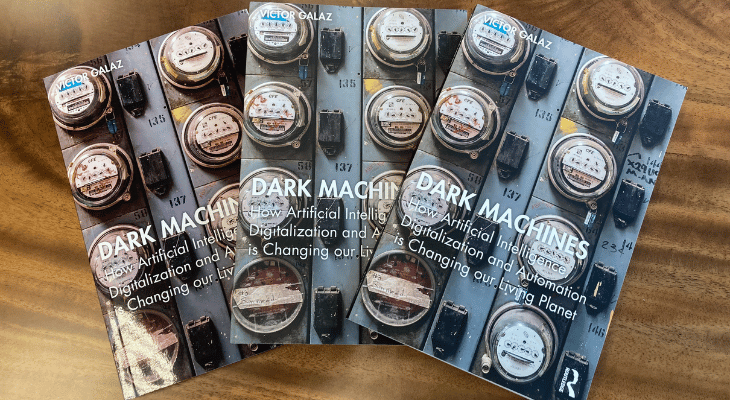
“I felt that the discussions on AI and sustainability were highly simplistic – it lacked a proper systems view, it failed to acknowledge the deep influence of power and politics, and the discussions did not include the living planet in all its complexity”, says Victor Galaz, who is also associate professor at Stockholm Resilience Centre at Stockholm University.
As the pressure of human activities accelerates on Earth, so too does the hope that digital and artificially intelligent technologies will be able to help us deal with dangerous climate and environmental change. The book Dark Machines explores why such an assumption is naïve and dangerous, exploring why AI and associated digital technologies instead may lead to accelerated discrimination, automated inequality, and augmented diffusion of misinformation, while simultaneously amplifying risks for people and the planet.
Galaz elaborates: “We are already seeing the material footprint of a growing AI-industry, of hardware, and the energy and water costs of AI-compute. We should also be concerned about how generative AI, with its ability to create highly convincing synthetic images, video and sound, is contributing to the increased diffusion of false climate information.”
The book conveys the message that of a profound challenge: either allow AI to accelerate the loss of resilience of people and our planet or act forcefully in ways that redirects its destructive direction.
“Steering technological change will always be a matter of combining technological, policy and social ingenuity,” says Victor Galaz: “There are technical ways to reduce harm, like energy efficient AI, or better recommender systems or filtering misinformation. But in the end, steering AI towards biosphere-based sustainability will require moving from self-regulation to legal and economic measures that push the industry to measure and cut its ecological and carbon footprint.”
Working with the book, mainly aimed at students and the broader research community, made him even more aware of how deeply affected all aspects of our lives are influenced by digital technologies:
“There is an urgency for sustainability scientists to engage critically with AI – as a research method, as a growing industry, and as new political actors shaping policy all over the world”, concludes Galaz.
Reference: Galaz, V. 2025. Dark Machines: How Artificial Intelligence, Digitalization and Automation is Changing our Living Planet. Routledge.
NEWS