NEWS • 2026-09-09
Blue foods can help address climate change, but there is no single solution.
A recent review examines climate mitigation and adaptation strategies across capture fisheries, aquaculture, and aquatic food systems. Its key message: there is no silver bullet.
Photo: IStock
Climate change poses severe challenges to blue food systems, affecting marine and freshwater production capacities as well as aquaculture feed supply, and post-production processes. At the same time, blue foods have been suggested to have significant potential for mitigating climate change by reducing carbon emissions. Therefore, investments in climate adaptation are needed to safeguard the nutritional, social, economic, and environmental contributions of blue foods.
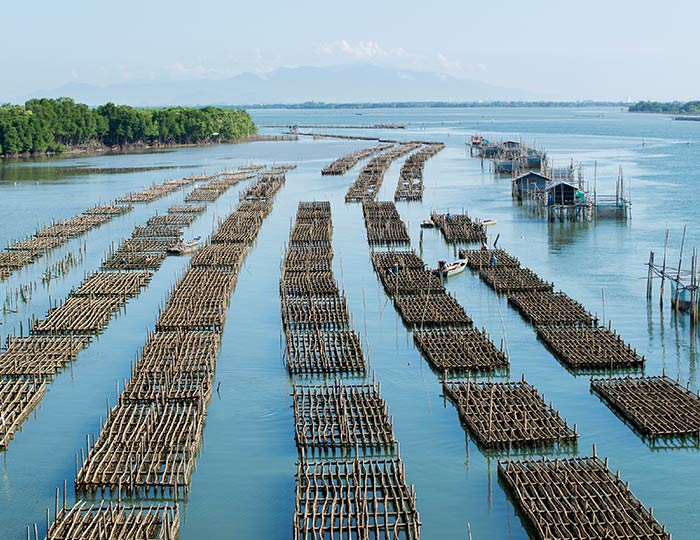
However, climate action in the sector is complex due to its diversity, with more than 2500 species harvested globally through methods ranging from backyard fish rearing to high-seas trawling, supplying local households to global luxury markets.
The review, published in Environmental Research: Food Systems evaluated 22 climate mitigation and adaptation strategies across fisheries and aquaculture, investigating how effective and feasible these strategies are, as well as the potential benefits, trade-offs, and links to other sustainable development goals.
Led by Aleah Wong from the UBC Institute for the Oceans and Fisheries, the review team includes the Beijer Institute’s Malin Jonell, Max Troell, and Patrik Henriksson, among others.
They found that while technological innovations often receive the most attention, their success depends on local social, ecological, and economic conditions. Equally important, but often overlooked, are governance, capacity building, equity, behavioural change, and community-led approaches.
“There is a tendency to look for blue food technological fixes, as their potential impacts are easy to measure and therefore attractive to investors,” says Malin Jonell. “However, our review shows that there is a risk of overlooking approaches focused on behaviour, governance and resilience. While these are more complex, they can be just as important for achieving long-lasting change.”
The authors argue that portfolios of complementary, context-specific strategies, with a systems perspective offer the greatest potential to transform blue food systems while balancing climate goals with nutrition, biodiversity, livelihoods, and sustainable development. They give three examples of such portfolio approaches from Africa and Asia.
“Investments in blue foods for climate adaptation and mitigation risk being guided by incomplete evidence of their benefits and trade-offs,” says Max Troell. “The challenge is not to identify a single “best” blue food solution, but rather to determine the combination of adaptation and mitigation strategies that can deliver the greatest benefits within a particular geographical, ecological, and cultural setting.”
The review also underscores that equity must be central to climate action. Inclusive decision-making, locally led implementation, and investments in community capacity are not simply desirable, they are essential for effective and lasting solutions.
Reference: Wong, A., M. Jonell, M. Tigchelaar, M. Troell, C. C. C. Wabnitz, E. H. Allison, K. Deering, P. J. G. Henriksson, K. M. Kleisner, J. Z. Koehn, J. G. Mason, M. S. Schutter, and E. R. Selig. 2026. Feasibility, co-benefits, and trade-offs of climate mitigation and adaptation strategies in blue food systems. Environmental Research: Food Systems 3:035007
NEWS