NEWS • 2025-12-18
Science as a collective process in turbulent times
In an era of rapid change, misinformation, and global uncertainty, questions about the role of science have become increasingly prominent. How can science maintain its integrity and authority as a foundation for collective action? What is the role of science in decision-making? These questions were at the heart of a lecture by Professor Naomi Oreskes, the 2025 Laureate of the Volvo Environment Prize, held in Stockholm on 11 December 2025.
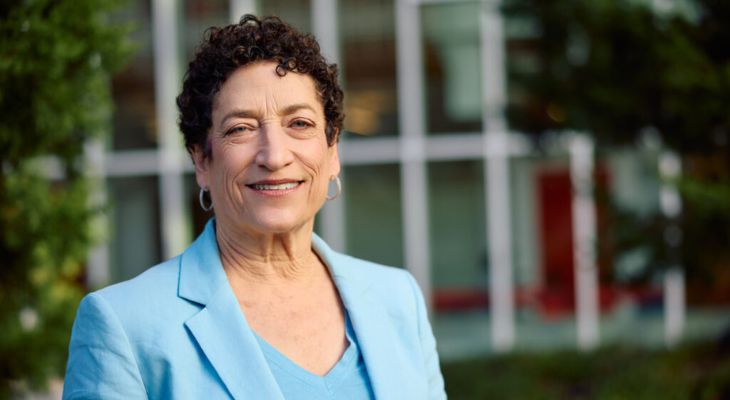
Photo: Volvo Group
Professor Naomi Oreskes is a leading earth scientist and historian, internationally recognised for her pioneering research on the history and philosophy of Earth and Environmental Sciences and on disinformation. She has played a key role in shaping contemporary understandings of how scientific knowledge – particularly climate science – has been deliberately silenced by disinformation linked to powerful commercial and political interests, and is the co-author of the acclaimed book Merchants of Doubt (2010). Oreskes holds the position of Henry Charles Lea Professor of the History of Science and serves as an Affiliated Professor of Earth and Planetary Sciences at Harvard University.
On 11 December 2025, Oreskes was awarded the Volvo Environment Prize 2025 at a ceremony held at Tändstickspalatset in Stockholm. After the award ceremony, Professor Naomi Oreskes participated in a seminar organised by the Beijer Institute, Stockholm Resilience Centre, and the Volvo Environment Prize Foundation. Carl Folke, former Director of the Beijer Institute, is Chair of the Scientific Committee which selects the laureate among nominees from all over the world, while current Director Emily Boyd is a member of the Committee. In its citation, the Volvo Environment Prize Jury highlighted the impact of Oreskes’ work:
“Bridging natural sciences and the humanities, Naomi Oreskes is an internationally renowned scholar in the disciplines of history, philosophy and geology. She is a public intellectual, and advocate with remarkable and tireless scientific, humanistic, and outreach contributions towards environmental stewardship and sustainability.”
Read more about the Award Ceremony
Science as a collective process
During her lecture, Oreskes focused on the collective dimensions of scientific knowledge production and why these remain crucial in what is often described as a turbulent time for science. While public debate may suggest that trust in science is eroding, she noted that overall confidence in scientific institutions remains relatively high. Turbulence, she argued, is not unique to the present; what has changed is how scientific uncertainty and error are increasingly exploited to cast doubt on well-established knowledge.
Oreskes emphasised that science has largely withstood the test of time, proving remarkably robust precisely because it is a collective enterprise. From formal peer-review processes to the fact that the scientific process fundamentally involves opening up findings and hypotheses to scrutiny from others, science advances through collective evaluation. She challenged the myth of individual genius, pointing that even figures such as Alfred Wegener and Charles Darwin were embedded in the national and international scientific networks of their time.
Objectivity, bias, and the scientific process
Another central theme of the lecture was scientific objectivity. Oreskes addressed the concern – and in some instances, criticism – that scientists’ engagement with policy or public debate might undermine their objectivity. She argued instead that science, as a human activity, is inherently fallible and shaped by biases, or “priors”. The most effective way to guard against such bias, she suggested, is to open up one’s work to scrutiny and criticism by others, who bring different perspectives and assumptions to the process. In other words, we might think about objectivity as a social accomplishment rather than an individual quality, which can be achieved not through discipline, but through participation in this collective process.
Finally, she spoke about the issue of neutrality in science, noting that scientists who speak publicly are sometimes characterised as activists. Oreskes argued that when scientists refrain from participating in public discourse, other actors may fill that space – after all, she reminded us, nature abhors a vacuum -, which increases the risk of disinformation. Engagement, she suggested, could be understood as part of scientists’ responsibility that scientific knowledge is accurately represented in societal discussions, and part of a process of science presenting solutions rather than just identifying problems.
Panel discussion
The lecture was followed by a panel discussion with Katherine Richardson, Professor of Biological Oceanography at the Globe Institute, University of Copenhagen; Norichika Kanie, Professor at the Graduate School of Media and Governance at Keio University; and Sverker Sörlin, Professor in Environmental History at KTH. The conversation was moderated by Thomas Elmqvist, Professor at Stockholm University.
The panel addressed the challenges facing science today, including how the scientific process can hold up in a world where knowledge is produced at an unprecedented speed and scale, and whether the collective process of science can adapt to the urgency and complexity of the Anthropocene. Topics included trust in science, dialogue between science and society, and the opportunities and challenges involved in translating scientific knowledge into action. The discussion also offered reflections and advice for early-career researchers navigating these dynamics.
The seminar was organised by the Beijer Institute in collaboration with Stockholm Resilience Centre and the Volvo Environment Prize Foundation.
NEWS