NEWS • 2026-05-05
Blue Gold — the promise and peril of our rush to use the ocean
Companies and governments are rushing to the ocean to feed humanity, fuel global economies and trade, and reverse climate change. We are asking a lot of the vast blue expanse that covers two-thirds of our planet. Are we asking too much? That is the topic for this Stockholm Seminar on 20 May 2026, held by Professor Ben Halpern, Director of the National Center for Ecological Analysis and Synthesis (NCEAS) in UC Santa Barbara.
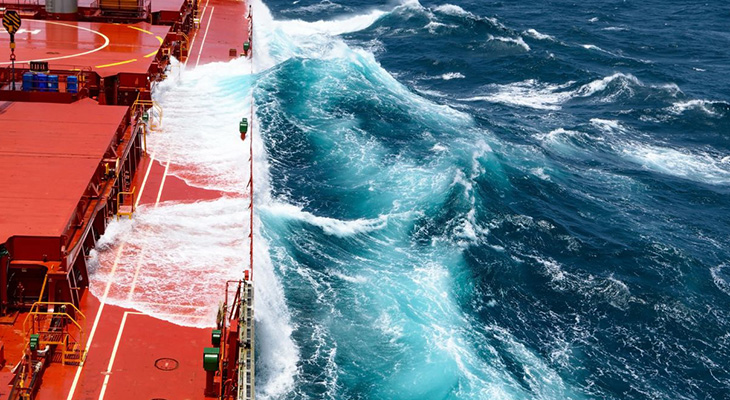
A cargo ship rolling in stormy Indian Ocean. Photo via Canva.
At the heart of this interest is a real possibility that the ocean could deliver on these expectations, that it can sustainably provide these resources while simultaneously allowing us to solve global sustainability challenges. Or we could do it all wrong and further damage the ocean, making the planet much worse off in the process.
In his talk, Ben Halpern will address the potential and risks associated with global efforts to use the ocean to extract resources – from food to energy and minerals – that together could transform our relationship with the planet and its sustainability.
Based on the latest science and technological developments, he will unpack each resource to understand what it offers, how it compares to other options, and how and where things could go terribly wrong if done poorly. Taken together, what emerges from these stories is an answer that may surprise you, one that could change how you think about the ocean, and ultimately your relationship with it.
When & Where
Wednesday 20 May 16.00-17.00 (CEST)
Linné hall, Royal Swedish Academy of Sciences, Lilla Frescativägen 4A, Stockholm
Register to join on site or online. Zoom link will be provided upon registration.
About the speaker
Ben Halpern focuses his research at the interface of marine ecology and conservation planning. His research has addressed a broad range of questions that span local to global scales, including spatial population dynamics, trophic interactions in community ecology, and the interface between ecology and human dynamics, all with the ultimate aim of informing and facilitating conservation and resource management efforts in marine systems.
About Stockholm Seminars
The Stockholm Seminars cover a broad range of sustainability science perspectives with a focus on the dynamics and stewardship of social-ecological systems. The seminars are usually held at the Royal Swedish Academy of Sciences and organised by the Beijer Institute of Ecological Economics, the Anthropocene Laboratory, and the Global Economic Dynamics and the Biosphere programme, all three at the Royal Swedish Academy of Sciences, together with Albaeco, Future Earth and Stockholm Resilience Centre. Since its start in 2000 more than 100 of the world’s leading scientists and experts have taken part in this seminar series, including Nobel Laureates.
See previous seminars in the series and subscribe to invitation list.
NEWS