NEWS • 2026-04-27
Exhibition exploring design for sustainable behaviour
How do we get people and societies to change their behaviour in a more sustainable direction? That question is at the heart of a collaboration between students at Beckmans College of Design, researchers at the Beijer Institute and its partners, and design firm Svenskt Tenn. The results are exhibited at Svenskt Tenn in Stockholm between 24 April to 3 May.
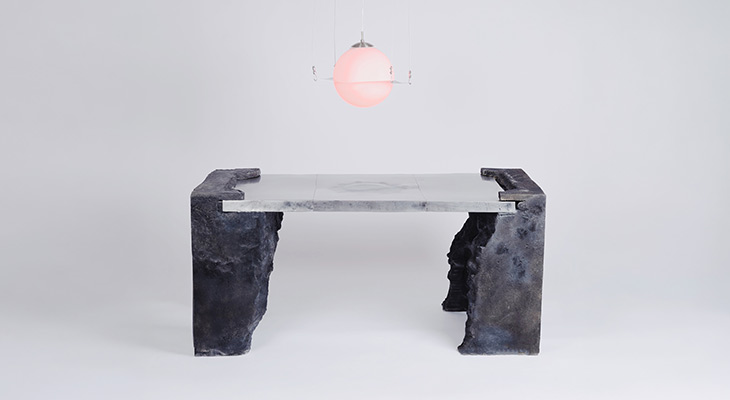
Common ground by Emma Ljungqvist, Tindra Berglund and Vivi Tang (researcher Maria Schewenius). photo: Ella Mclaren Poulter
In close dialogue with the researchers, design students have explored how everyday choices, often shaped more by habit than by conscious decision-making, can be influenced through design.
The exhibition Breaking the Patterns We’ve Created presents six visual interpretations of research on sustainable behaviour. Together, the projects investigate how subtle changes in our surroundings can make sustainable choices feel more natural and accessible.
“We often know what the right choice is, yet fail to act accordingly. Our behaviours are largely shaped by the environments we live in, and that’s where design can play a decisive role,” says Sophia Wood, Head of the Visual Communication programme at Beckmans College of Design.
Questioning old habits
While the exhibition is grounded in major global challenges, such as climate change and biodiversity loss, it shifts the focus to the everyday: how we consume, move, and use resources in our daily lives.
The works include a car with four steering wheels, illustrating that by establishing a norm where everyone steers together, we eliminate passivity and change direction faster.
“Volkstyre – Das Allo calls for conscious participation, demonstrating that collective action is key to mitigating climate change and fostering mutual responsibility, engagement and inclusion”, is the message from the students Fahed Dehchar, Jesper Smeding and Simon Grey.
Another group has created a dinner table and lamp made of materials that also shape, cities: concrete, steel and glass. The table is meant to spark conversations around how these materials govern how our urban environments function, for instance through absorbing heat but preventing the ground to absorb rain water.
“The table is one of our most instinctive places to gather, where attention is shared
and the gaze is directed toward a common surface”, says students Emma Ljungqvist, Tindra Berglund and Vivi Tang.
Therese Lindahl, Programme Director at the Beijer Institute, appreciated the opportunity to engage with students:
“It was exciting to see which aspects of our research the students picked up on, and the perspectives they chose in their interpretations. It was also a real pleasure to see their creativity in action and how curious they were to learn more about the subject.”
About the collaboration
The design firm Svenskt Tenn is owned by the Beijer Foundation which in turn provides the core funding for the Beijer Institute, and other research institutions. To create awareness of the world-leading research conducted, Svenskt Tenn initiated a collaboration between Beckmans and the Beijer Institute in 2017.
Participating Researchers
Anne-Sophie Crépin – The Beijer Institute
Therese Lindahl – The Beijer Institute
Noah Linder – The Global EconomicDynamics and the Biosphere Programme, Royal Swedish Academy of Sciences
Maria Schewenius – Stockholm Resilience Centre, Stockholm University
NEWS