NEWS • 2026-10-01
Symposium: Cultivating Resilience
What does it take to cultivate resilience, in ecosystems, societies and science? At a symposium 14 September, celebrating Professor Carl Folke, colleagues and collaborators reflected on decades of research, mentorship and network building, while looking ahead to the transformations still needed.
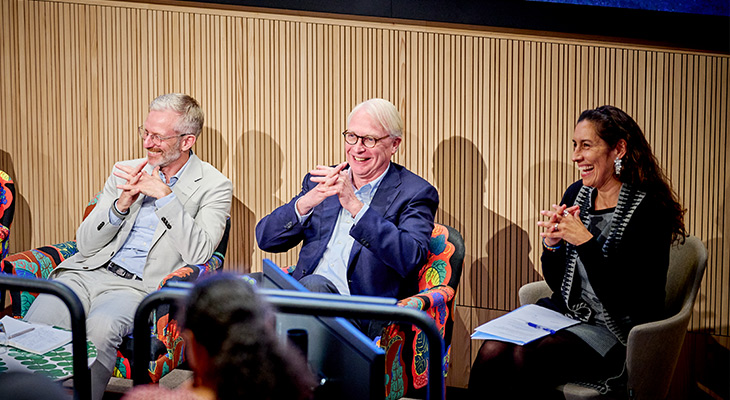
Carl Folke (middle) with Henrik Österblom, Anthropocene Laboratory and Beatrice Crona, GEDB. Together with Line Gordon, Stockholm Resilience Centre (out of view), three leaders of institutions Carl Folke co-founded. Photo: Patrik Lundin.
Over several decades, Carl Folke’s work has helped shape sustainability science, resilience thinking, ecological economics and research on social-ecological systems. Throughout the day, speakers emphasised that his legacy is also about the people, relationships and communities built around these ideas.
Seeing potential and opening doors
A recurring theme was Folke’s generosity as a mentor and openness to researchers across disciplines and generations.
“Sometimes you see people’s identity and potential before they even realise it themselves,” said Line Gordon, director of the Stockholm Resilience Centre, reflecting on Folke’s encouragement of younger researchers.
Beatrice Crona, GEDB executive director, described Folke’s career through the metaphor of a cartographer:
“You wandered through uncharted terrains together with other island people, drawing a map and handing it to anyone wanting a copy, and inviting them to join.”
For many speakers, this willingness to cross disciplinary boundaries was central to Folke’s contribution, connecting economics and ecology, people and nature, theory and practice.
However, breaking boundaries does not happen without friction, and that’s a point, emphasized Dr Jamila Haider, Stockholm Resilience Centre:
“When ideas collide, there is tension. Carl Folke encourages us to stay in this tension because that is where new ideas can be born.”
Bringing people and nature together
Professor Elena Bennett, McGill University, reflected on a broader shift in environmental thinking, from a focus on nature, to nature for people, and increasingly towards understanding people and nature as one interconnected system. Folke’s work, she argued, played an important role in that shift.
Elena Bennett and several others, including Stanford University professor Gretchen Daily, testified to how Folke’s willingness to bring ecology, economics and social sciences in dialogue created intellectual spaces that they had struggled to find.
For Professor Marten Scheffer, Wageningen University, Folke’s contribution was also about asking the right questions.
“Carl doesn’t start with asking for the solutions, rather he has always brought the ability to ask the right questions,” he said.
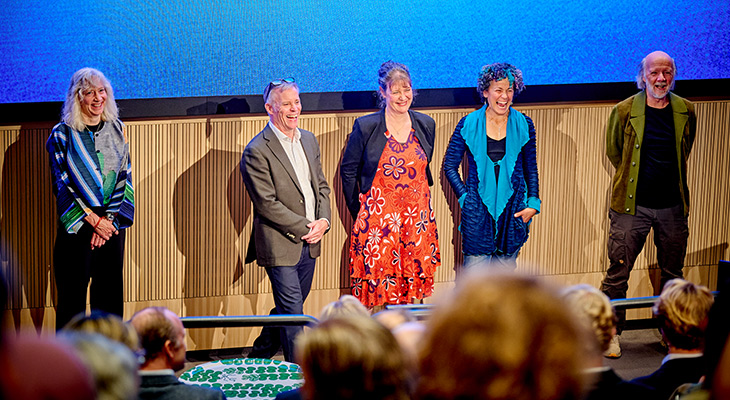
Gretchen Daily, J. Marty Anderies, Anne-Sophie Crépin, Elena Bennett and Marten Scheffer. Photo: Patrik Lundin.
We are not starting from scratch
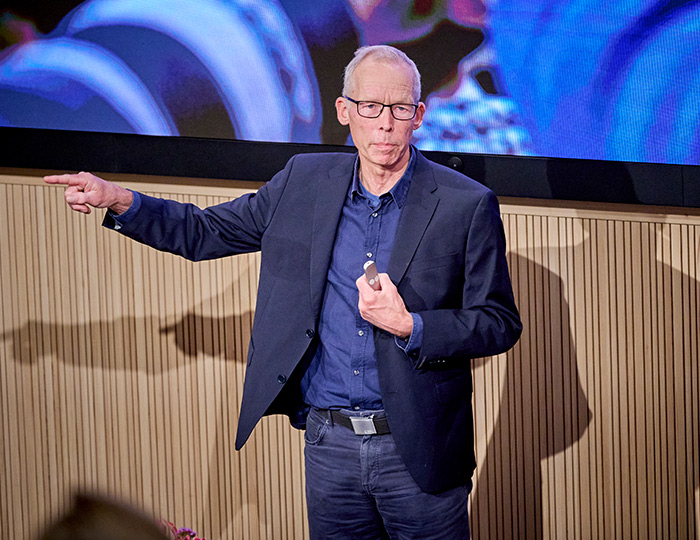
Johan Rockström. Photo: Patrik Lundin.
The session Seeds of Resilience traced the evolution of resilience research to today’s questions of transformation and planetary change.
Professor Johan Rockström, director of Potsdam Institute for Climate Impact Research (PIK), brought these ideas into sharp focus, warning that the planet is “fundamentally at risk within decades, on our watch.” He highlighted four interconnected virtues for moving beyond the current trajectory: reconnecting with the biosphere, recognising that change is already underway, pursuing planetary justice, and strengthening humanism through trust and collective action.
At the same time, Rockström, who together with Folke and others co-founded Stockholm Resilience Centre, stressed that society is not starting from zero. Knowledge, networks and institutions built over decades provide foundations for change. “The challenge now isn’t if we will succeed or not, but if we will succeed too late.”
Folke echoed this perspective: “The ball is already rolling.” The task, he said, is to understand how to accelerate transformation and prepare for the changes ahead.
In his talk he also paid tribute to scholars that had opened his eyes to new ideas and new research paths, among them Professors AnnMari and Bengt-Ove Jansson, systems ecologists and pioneers in interdisciplinary science.
A legacy built through networks
Professor Garry Peterson, Stockholm Resilience Centre, highlighted Folke’s role in building international research networks such as the Resilience Alliance, connecting people and ideas across institutions and continents:
“Part of your legacy is forming a global network of social-ecological research hubs.”
Across the day, speakers returned to the qualities that characterise Carl Folke: curiosity, openness, persistence, generosity and, not least, humour. Several recalled how Folke’s humour helped break down academic hierarchies and create spaces for sharing ideas.
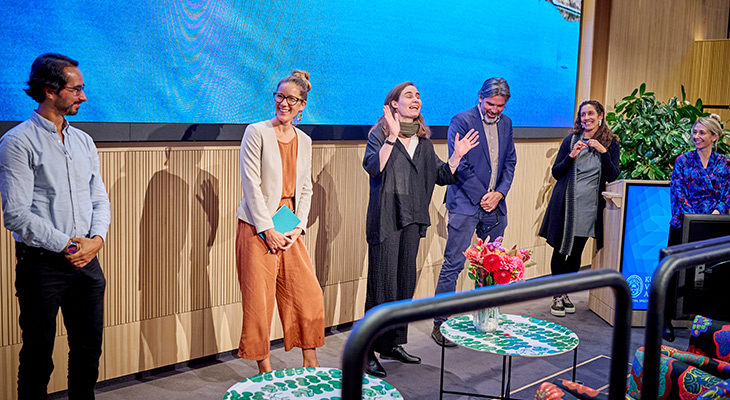
Juan Rocha, Jamila Haider, Caroline Schill, Garry Peterson, Beatrice Crona and Malin Jonell. Photo: Patrik Lundin.
Imagining futures
The final panel asked what the next frontiers of resilience research might be.
Questions ranged from how to bring local and indigenous knowledge more fully into research, to how to prepare for mass migration, conflict and other large-scale disruptions. Participants discussed the need for new forms of sustainability diplomacy, stronger capacity building and a better understanding of how institutions can support transformation.
The discussion also returned to a question: How can knowledge become action?
For the community gathered at the symposium, the answer lies partly in the same approach that has characterised Folke’s career, asking ambitious questions, crossing boundaries, building relationships and creating creative spaces where new ideas can take root.
Carl Folke himself conveyed hope through citing 70’s rock group Crosby, Stills and Nash:
“But you know the darkest hour is always just before the dawn.”
NEWS